
- •Shot location entropy is a genuinely stable team trait - persistent year over year (average r = +0.57 across seven seasonal transitions)
- •Lower entropy (more concentrated shooting) predicts higher expected goals per shot (partial r = -0.164, p = 0.009) - the only confirmed predictive relationship
- •Entropy reflects real offensive structure: coaching systems, personnel deployment, and strategic philosophy - not noise
- •633,318 shots across 253 team-seasons (2018-2026), using MoneyPuck's arena-adjusted data
The Question
In 2015, a team of researchers at Harvard, Alex D'Amour PhD, Dan Cervone PhD, Luke Bornn PhD, and Kirk Goldsberry PhD, presented a paper at the MIT Sloan Sports Analytics Conference that reshaped how we think about offensive basketball. The paper was called Move or Die: How Ball Movement Creates Open Shots in the NBA, and its central finding was elegant: teams whose ball movement was more unpredictable, as measured by Shannon entropy, created better shots. Entropy, the information-theoretic measure of disorder, wasn't just a metaphor for good offense. It was good offense.
The logic was intuitive: if the defense can predict where the ball is going, they can close passing lanes and contest shots. If they can't, gaps open. The work spawned a generation of entropy-based basketball metrics, and the framework has since been applied to other invasion sports, including a 2023 study by Lord, Welvaert, and Mara that used Shannon entropy to measure unpredictability in international field hockey ball movement patterns.
But nobody has applied it to ice hockey. Not to NHL shot patterns, anyway. The public hockey analytics community has built increasingly sophisticated tools for measuring shot quality, such as expected goals models from MoneyPuck, Evolving Hockey, and others; HockeyViz's shot distribution maps; Natural Stat Trick's scoring chance zones. What's missing is the information-theoretic layer: not just where teams shoot from, but how predictable those patterns are, and whether that predictability matters.
So I pulled MoneyPuck's shot-level data for eight NHL seasons — 633,318 shots at 5v5, arena-adjusted coordinates, expected goals models — and built an entropy framework for how teams distribute their shots across the ice surface. Not play-by-play event sequences, which are contaminated by rink-recording differences, but the actual shot patterns: where do teams shoot from, and how predictable are those locations?
The answer is more interesting than "yes" or "no." One finding survived every statistical correction I could throw at it. Others collapsed under scrutiny. And at the center of the story is a team whose entropy profile is perfectly average, and whose results are anything but.
Entropy in 30 Seconds
Entropy, borrowed from information theory, measures unpredictability. Applied to hockey: if I told you a team was about to shoot, how surprised would you be by where the shot comes from?
A team that shoots exclusively from the slot has low entropy, meaning you always know where the shot is coming from. A team that shoots equally from the crease, the point, the circles, and the high slot has high entropy, such that each shot could come from anywhere.
I divide the ice into 12 shooting zones, count what fraction of a team's shots come from each zone, and compute Shannon entropy. The result is a number between 0 and 1. In practice, NHL teams range from about 0.80 to 0.86. That range is small, but as we'll see, the differences within it are real and persistent.
The Stability Result
The first thing I needed to establish was whether shot location entropy is signal or noise. If teams' entropy values bounce randomly from season to season, there's nothing to study. It's just dice rolls.
It's not dice rolls.
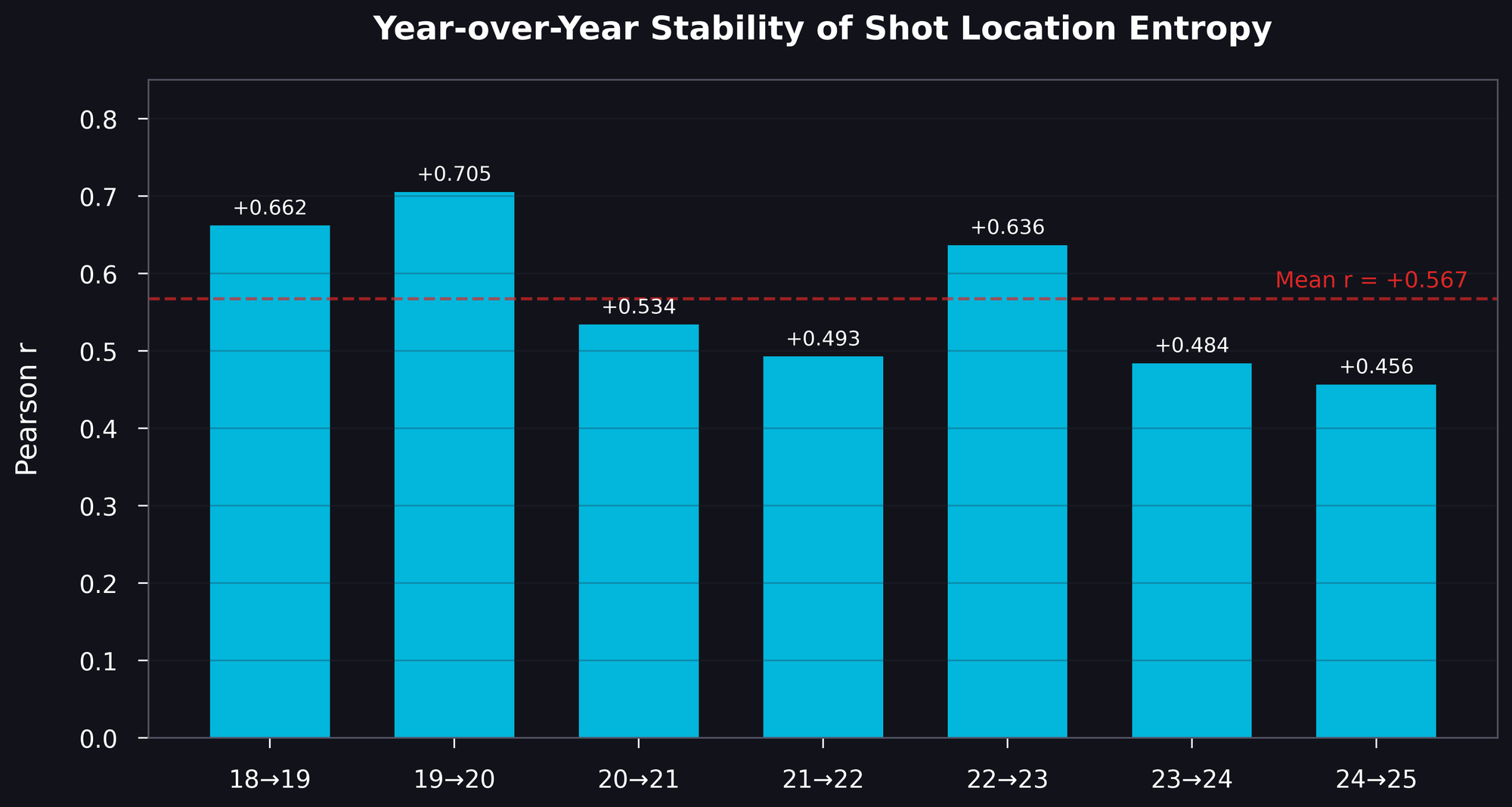
An average year-to-year correlation of r = +0.57 across seven seasonal transitions is strong for a team-level hockey metric. It is consistent with persistent organizational factors, such as coaching philosophy, personnel deployment, and strategic intent. Entropy does consistently.
What this means: shot location entropy reflects something real about how organizations play hockey. It captures coaching philosophy, personnel deployment, strategic intent, the structural choices that persist even as rosters turn over and assistants change. Carolina has been a high-entropy, high-volume team for eight straight years. St. Louis has been low-entropy for five. These aren't flukes. They're organizational identities.
The One Finding That Survived
Across eight seasons and 253 team-season observations, shot location entropy shows exactly one robust association: lower entropy is associated with higher expected goals per shot
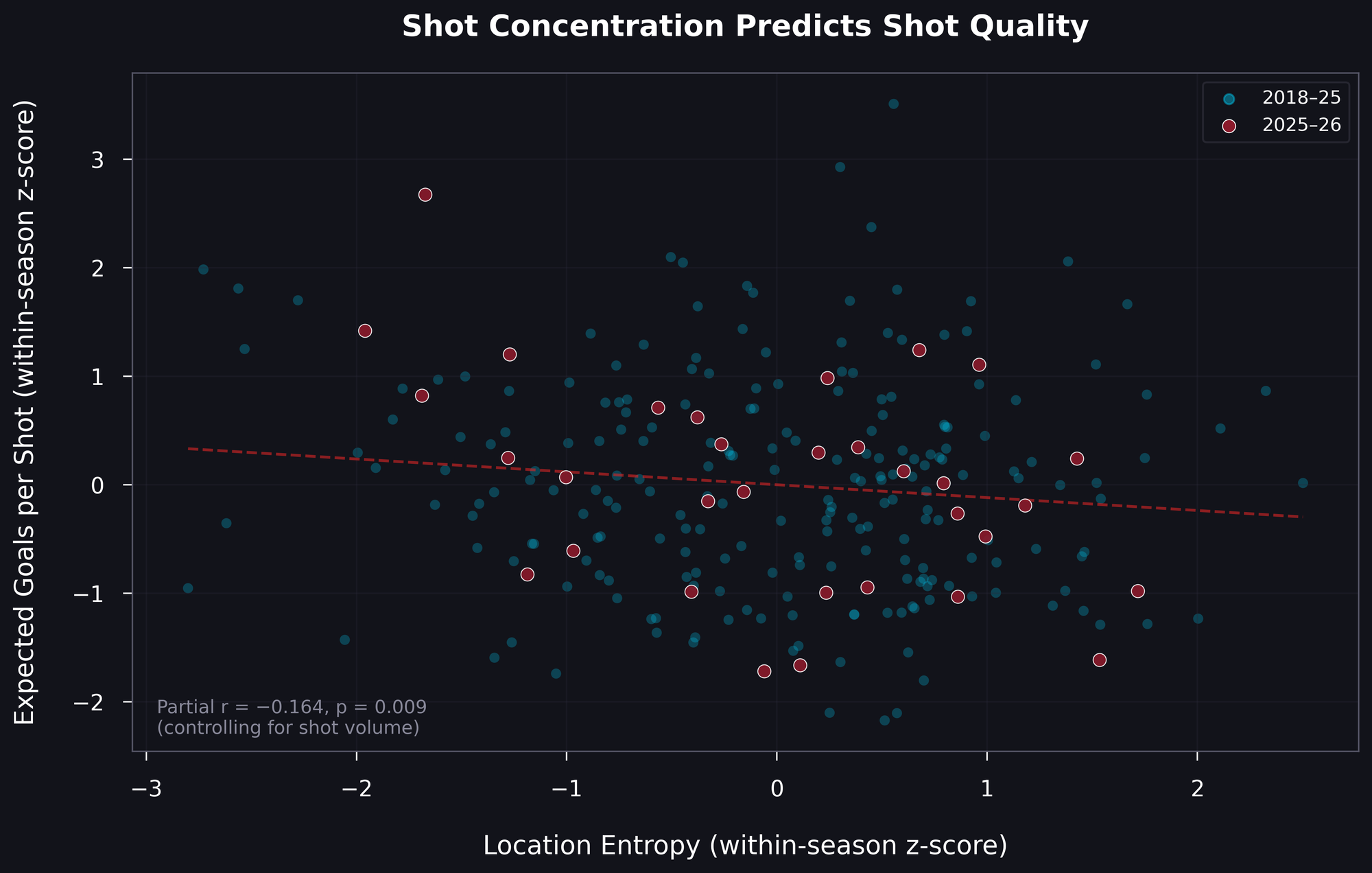
After controlling for shot volume (because teams that shoot more tend to have higher observed entropy, due to both sampling and offensive-process effects) and standardizing within each season (to account for league-wide trends), the partial correlation is r = −0.164, p = 0.009. The direction is consistent in seven of eight individual seasons.
This is intuitively correct. Teams that concentrate their shooting from the slot, the crease, and high-danger areas are selecting better shots. They're avoiding the point shots and sharp-angle attempts that drag down expected goals. Entropy here is measuring shot selection discipline, which is the ability to resist taking a bad shot when a good one isn't available.
The cleanest finding in the entire analysis: more concentrated shot location distributions are associated with better expected goals per shot. The direction holds in seven of eight seasons and remains after within-season standardization and adjustment for shot volume.
But here's the critical caveat — the one that sets up everything in Part 2: better shot quality per shot does not automatically mean more goals or more wins. A team can have excellent per-shot quality and still be terrible if they don't generate enough shots. And the teams with the best shot discipline turn out to be among the worst in the NHL.
Where Every Team Stands
Here are the current 2025-26 location entropy rankings through the Olympic break, roughly 57 games per team. Lower values mean more concentrated shooting. The colors indicate offensive archetypes — you'll learn what those mean in Part 2.
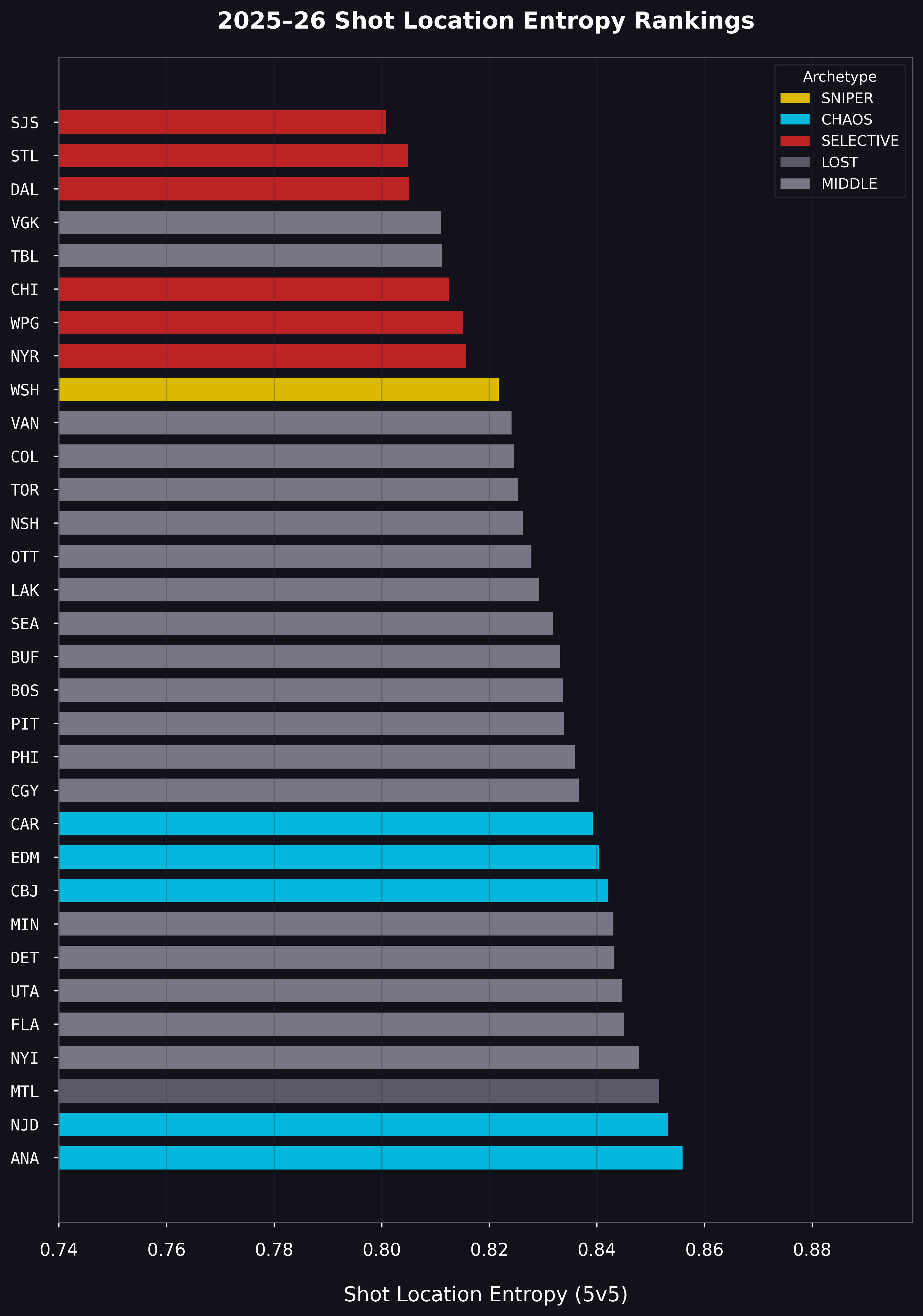
Scan that chart. The most concentrated teams (San Jose, St. Louis, Dallas) and the least concentrated (Anaheim, New Jersey, Montreal) are a mix of good and bad. Colorado, the best team in hockey, sits at #11 (right in the middle). The rankings alone don't tell you who wins.
But entropy, crossed with shot volume, reveals something the rankings alone don't. The most disciplined offenses in the NHL are also its worst. That's Part 2: The Concentration Trap.
All data from MoneyPuck.com's shot-level dataset, 2018–19 through 2025–26 (partial season). Analysis restricted to 5v5 situations, excluding blocked shots (i.e., unblocked shot attempts). Shot coordinates are arena-adjusted using the Schuckers-Curros method. Location entropy uses a 12-zone spatial model and Shannon entropy normalized by log₂(12). Year-to-year stability is summarized with Pearson correlations across seasonal transitions. The xG/shot analysis uses within-season z-scores and partial correlations controlling for shots per game. Because observations are repeated team-seasons (not fully independent), effect sizes should be interpreted as associations rather than causal estimates.
Prior work: The entropy framework draws on D'Amour, Cervone, Bornn, and Goldsberry, "Move or Die: How Ball Movement Creates Open Shots in the NBA" (MIT Sloan Sports Analytics Conference, 2015). Cross-sport application: Lord, Welvaert, and Mara, "Predicting the unpredictable: analyzing the entropy and spatial distribution of ball movement patterns in field hockey" (PLoS ONE, 2023). To the best of my knowledge, this is the first public application of Shannon entropy to NHL shot location distributions.
This is Part 1 of a three-part series.
Part 2: The Concentration Trap — why the NHL's most disciplined offenses are its worst.